THE FUTURE OF ARCHITECTURE: TRENDS AND PREDICTIONS
Articles
24.10.20
The world is becoming more complex. Therefore, the requirements for the architectural environment are increasingly growing. Architects are faced with the task of translating the needs of a constantly evolving and changing society into tangible, effective, and sustainable solutions.
Today, they must address the climate crisis, over-urbanization, population density, and housing shortages. All of this requires radically new approaches.
In this study, we will look at the latest ideas that could become an integral part of architectural reality, and thus our everyday life, tomorrow. Let’s go to the new world!
1. AI
The development of AI is already having a major impact on the world of design and architecture. It is likely that this influence will only grow in the future and will affect both stylistic and technical components.
For example, the field of architectural design may start progressing much faster than in recent decades. Structural miscalculations, which are an integral part of construction, should reach a different level of speed and complexity. This will provide new opportunities that are hard to imagine.
Stylistically, a whole layer of AI artists/architects specializing in the generation of architectural visuals has already formed. This approach is gaining more and more supporters, but this is only the initial stage, which should progress significantly in the next 2-3 years. On the other hand, we can already see how traditional designers are inspired by the generated forms. That is, the cycle of learning from human to AI has already been reversed in some places.
Prediction: architectural projects will be able to be created much faster, both in terms of miscalculations and instantly generated style options. We expect new interesting and complex solutions.

2. 3D PRINTING
Along with the development of AI, 3D printing will also progress, which is just at the beginning of its development, so it is not yet widely available and super efficient. But this is likely to change soon.
The technology is developing rapidly and leading architectural teams are already using it. 3D printing provides new opportunities, namely the speed and stability of the procedure for the construction of architectural objects, optimization and automation of processes.
Currently, there are printers on the market that print fairly simple shapes. But the technology is progressing, so we expect that soon it will start working with really complex forms. This means that they will become cheaper, more sustainable, and more accessible.
Prediction: with this technology, houses can be built in a much shorter time, processes will be automated and optimized, and thus become cheaper.

3. LIFE UNDERGROUND
Conflicts and tensions are on the rise around the world. We don’t know yet whether military threats will become a regular occurrence in the near future, but it is clear that it is safer to be underground. After all, it protects architectural structures, and thus the infrastructure with people, not only from possible attacks or nuclear explosions, but also from natural disasters, weather anomalies, etc.
Many of the world’s top businessmen and celebrities are already working on creating personal bunker palaces or entire cities, and the latest architectural designs of important social buildings include a shelter or shelter.
Therefore, in the future, military and important infrastructure facilities, as well as social and even private buildings, may be located below ground level. Concepts and sometimes realizations of bunker houses are steadily emerging. Such combinations will continue to evolve, and this will require new ideas in architecture and design.

Prediction: buildings not above the ground but below it will become commonplace. This will affect architecture and design no less than the emergence of skyscrapers.

4. BIOPHILIA
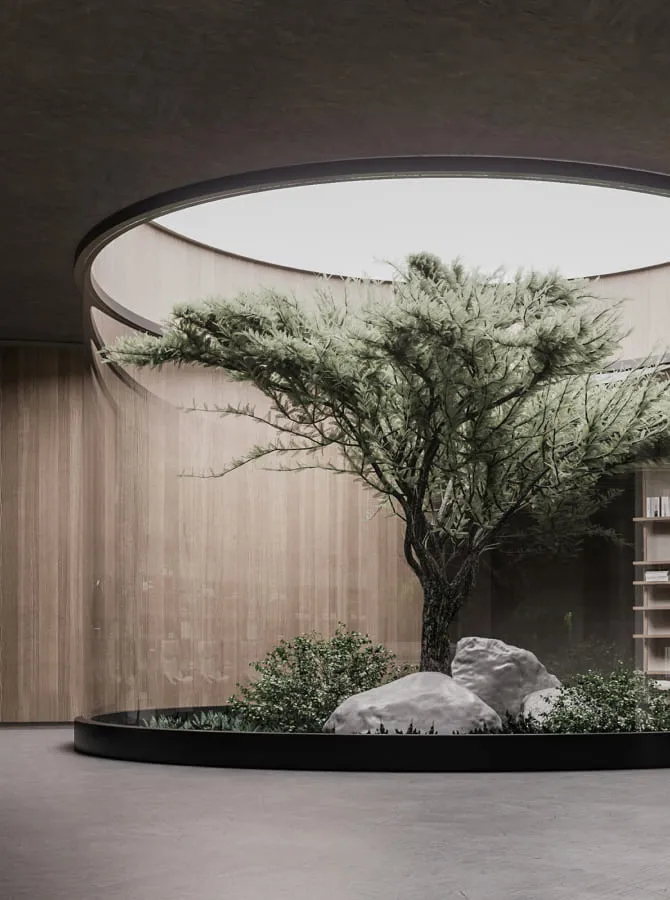
It is no longer just about a few plants in pots. Biophilic design integrates nature into every corner of the building, and in fact, designs the building as a real living ecosystem. It includes the integration of living walls, biological filters, and self-healing materials. These spaces look more like serene forests, gardens, and parks than concrete jungles.
This is a story about using natural processes and structures as a basis for design and construction. For example, living facades: the integration of living plants/organisms into facades and other parts of a building to improve air quality and energy efficiency.
It also uses self-healing materials containing bacteria or special polymers that fill cracks and defects. And they behave like living tissue, or partially are.
Forecast: biophilic architecture will help to increase the sustainability and efficiency of buildings by using natural processes. It will also improve the interaction between architecture and nature, for healthier and more productive living environments. After all, living in such a building is much more pleasant.

5. POST-ECOLOGICAL DESIGN
Who knew that saving the planet could look so stylish? Just look at the buildings with sustainable technologies such as green roofs, solar panels and innovative materials, as well as vertical gardens, rainwater harvesting systems and wind turbines. All this reflects the trend well.
Post-ecological design emphasizes the creation of architecture that not only meets environmental standards, but also actively improves the environment and even restores natural resources.Integrates technologies that allow buildings to recycle waste, generate energy or purify water. Clean eco-materials are used, such as recycled wood, biomaterials (bamboo, cork, etc.), and fabrics made from natural fibers. Sustainable design also includes the recycling and reuse of furniture and accessories.
Positive impact on ecosystems and the environment. Restoring resources and improving the ecological balance.
Prediction: This approach to design will have a positive impact on ecosystems and the environment. It will restore nature’s resources and improve the ecological balance. It will also significantly reduce the cost of living in such energy-efficient buildings.

6. INTERACTIVE ARCHITECTURE
An ancient dream of mankind is buildings that can change their shape and functionality depending on the conditions or needs of users. This is especially important in the face of rapid social and economic change, where it is necessary to adapt at lightning speed.
Adaptive buildings can have dynamic elements, such as movable facades that regulate lighting or heat. This also includes modular architecture and multifunctional transformer spaces that allow you to easily and quickly change the functional purpose of the premises. An interesting point is adaptive smart materials. For example, thermochromic and photochromic materials that change color when exposed to heat or light.
Forecast: This trend is an island of stability in the rising tide of planetary change. You will be able to adapt your home to any challenges, because it will be able to change with you.

7. FLOATING HOUSES
This is a solution for adapting to environmental changes, namely rising sea levels due to global warming. The problem of continental overpopulation will be solved by floating buildings and structures on pontoon bases.
These can be individual elements of city recreation, residential buildings, and entire towns with their own industrial production – fish and shellfish farming, cultivation of beneficial algae, etc.
The use of environmentally friendly materials will provide significant long-term benefits. Also, water energy can be used as its own power source, which will make such structures energy-independent.
Forecast: If sea levels continue to rise, more and more ideas like this will come up. Very soon, the economic basis for them will be justified, and then a new colonization of the seas and the next great migration will begin.

8. CITY IN ONE BUILDING
Horizontal settlement is the depletion and overuse of the planet’s land resources. How to respond to this challenge? Imagine, instead of an entire street, only one building – a complete infrastructure center to live comfortably and fully without even stepping foot in the building. It’s about giant complexes that create a whole world inside themselves with their own ecosystem.
How will such a city be organized? Different levels will have different types of housing – private housing, offices, recreational areas, medical and educational institutions, law enforcement agencies, etc. Such a center will have an autonomous power supply using solar, wind, and other primary and backup sources.
Optimized transportation hubs through and around the complex will make it possible to avoid traffic jams. Own vertical green farms will be automated and use rainwater for irrigation. They will not only provide fresh food, but will also fit in well with the environment and be the green “lungs” of the building.
Forecast: Such ideas have both supporters and opponents. It all sounds a bit fanciful, but several such projects are already being implemented in Asia and Arab countries. If this becomes a common practice, we will no longer think in terms of a city dweller, but only as a homeowner.